
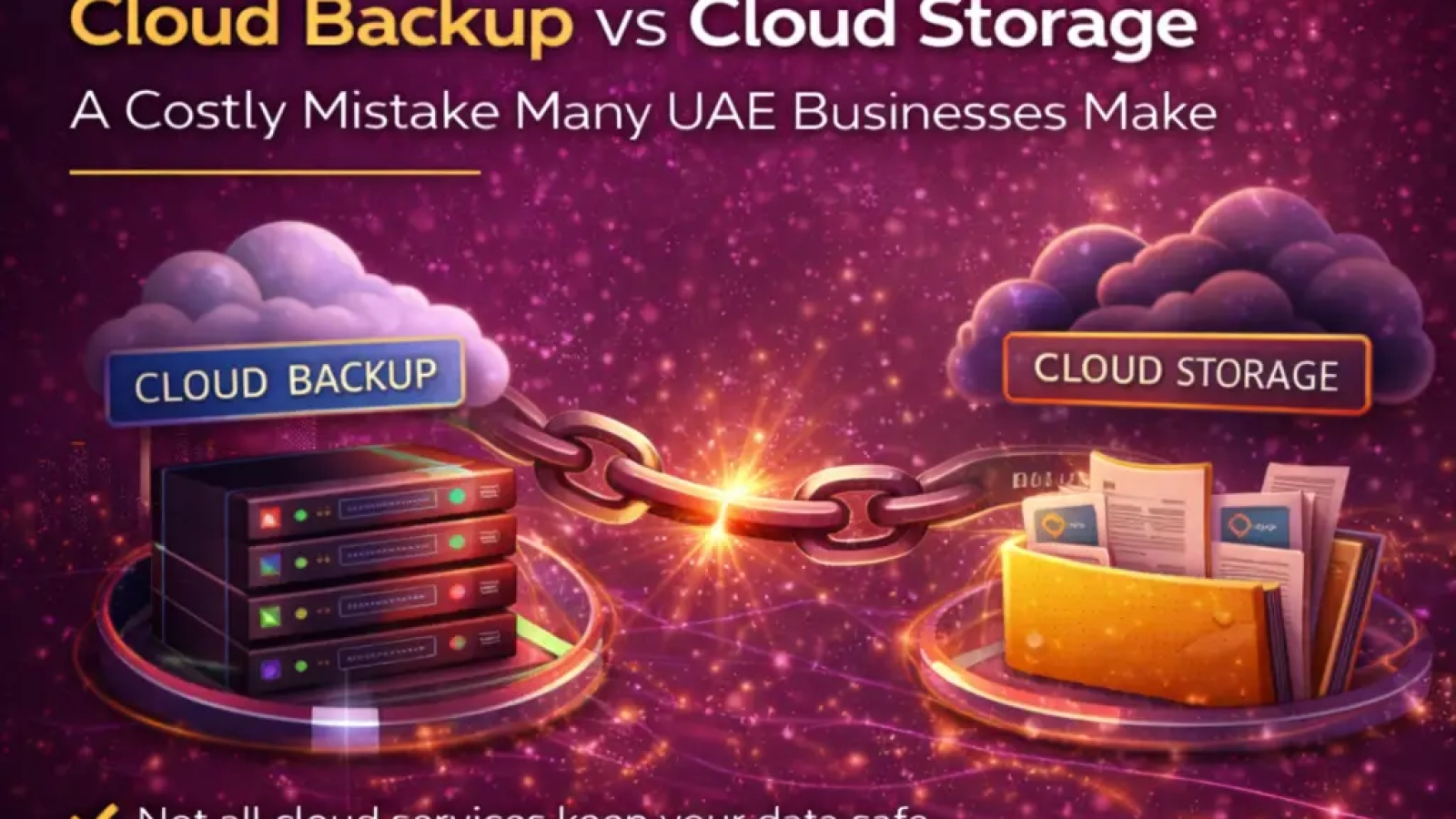
Cloud Backup vs Cloud Storage: A Costly Mistake Many UAE Businesses Make
Cloud adoption in the UAE has accelerated rapidly. Businesses now store accounting data, emails, contracts, designs, customer records, and operational systems in the cloud. Yet one critical misunderstanding continues to cause serious financial and operational damage: confusing cloud storage with cloud backup.
Many UAE businesses assume that because their data is stored in the cloud, it is automatically protected. This assumption is incorrect—and often only discovered after data loss, ransomware incidents, accidental deletions, or compliance failures.
This article explains the difference between cloud storage and cloud backup, why the confusion is so dangerous, and how businesses can avoid a costly mistake.
Why This Confusion Is So Common in the UAE
Cloud services are often marketed as “secure,” “redundant,” and “always available.” While these claims are partially true, they are frequently misunderstood.
Most businesses use platforms such as:
- Microsoft 365
- Google Workspace
- Cloud file drives and shared folders
- Hosted accounting and ERP systems
Because these platforms are reliable, businesses assume they also function as backups. They do not.
What Cloud Storage Actually Is
Cloud storage is designed for access and collaboration, not recovery.
It allows businesses to:
- Store files centrally
- Share documents with teams
- Access data from anywhere
- Synchronize files across devices
If a file is deleted, overwritten, or corrupted, that change is usually synchronized instantly across all devices and users.
In simple terms:
Cloud storage mirrors your mistakes as efficiently as it mirrors your data.
What Cloud Backup Is (and Why It Is Different)
Cloud backup is designed for data recovery and business continuity.
A proper cloud backup system:
- Creates independent, time-based copies of data
- Retains multiple versions over defined periods
- Protects against deletion, corruption, and ransomware
- Allows restoration to a specific point in time
Backup systems operate separately from day-to-day file access and are governed by retention and recovery policies.
The Costly Risks of Relying Only on Cloud Storage
1. Accidental Deletions
Employees regularly delete or overwrite files unintentionally. In cloud storage:
- Deleted files may sync instantly
- Retention periods are limited
- Recovery windows are short or nonexistent
Once the retention period expires, data is permanently lost.
2. Ransomware and Cyberattacks
Ransomware does not care whether data is on a local server or in the cloud.
When ransomware infects a synced device:
- Encrypted files sync back to cloud storage
- Clean versions are overwritten
- Businesses lose access across all users
Without an isolated backup, recovery options are limited.
3. Insider Errors and Malicious Actions
Not all data loss is accidental.
Examples include:
- Disgruntled employees deleting shared folders
- Incorrect permissions exposing or removing files
- Unauthorized changes made by third-party vendors
Cloud storage logs activity—but logs do not restore data.
4. Compliance and Audit Failures
Many UAE businesses are subject to:
- Tax record retention requirements
- Financial audit trails
- Regulatory data retention obligations
If historical data cannot be restored when requested, businesses may face penalties, audit qualifications, or legal exposure.
Why “Built-In” Cloud Protection Is Not Enough
Cloud providers protect their infrastructure, not your business decisions.
They ensure:
- Server uptime
- Hardware redundancy
- Platform availability
They do not guarantee:
- Recovery from user error
- Protection against logical data loss
- Long-term retention for compliance
This responsibility gap is where many businesses get caught off guard.
Real-World Scenarios Seen in UAE Businesses
Common situations include:
- Accounting data overwritten during year-end adjustments
- Email archives lost during staff exits
- Design files permanently deleted during project revisions
- CRM data corrupted after system integrations
In almost every case, the business believed its cloud platform was “fully backed up.”
Backup Is Not an IT Luxury—It Is a Business Control
Cloud backup should be treated as a risk management and governance requirement, not a technical add-on.
A proper backup strategy includes:
- Independent backup systems separate from production platforms
- Defined retention policies aligned with legal requirements
- Regular recovery testing
- Restricted access to backup environments
- Monitoring and reporting
Backup only works if it can be restored.
The Cost Argument That Backfires
Many businesses avoid backup solutions to reduce monthly costs. This is short-term thinking.
Compare:
- Monthly backup cost: minimal and predictable
- Cost of data loss: downtime, reputational damage, compliance penalties, lost clients
In almost every case, the cost of not backing up far exceeds the cost of doing it properly.
How UAE Businesses Should Approach Cloud Data Protection
To avoid this common mistake, businesses should:
- Clearly separate cloud storage and backup functions
- Implement third-party or independent backup solutions
- Align backup retention with tax and legal requirements
- Educate management—not just IT teams—on data risk
- Periodically review backup coverage as systems change
Cloud adoption without backup planning is incomplete.
Final Thoughts
Cloud storage is an excellent tool for collaboration and efficiency. But it is not a safety net.
Many UAE businesses only realize the difference between cloud storage and cloud backup after something goes wrong—when recovery is no longer possible. At that point, the damage is already done.
Understanding this distinction and investing in proper backup architecture is not just an IT decision. It is a business continuity, compliance, and risk management decision that every organization must address.
Add a Comment
You must be logged in to post a comment