
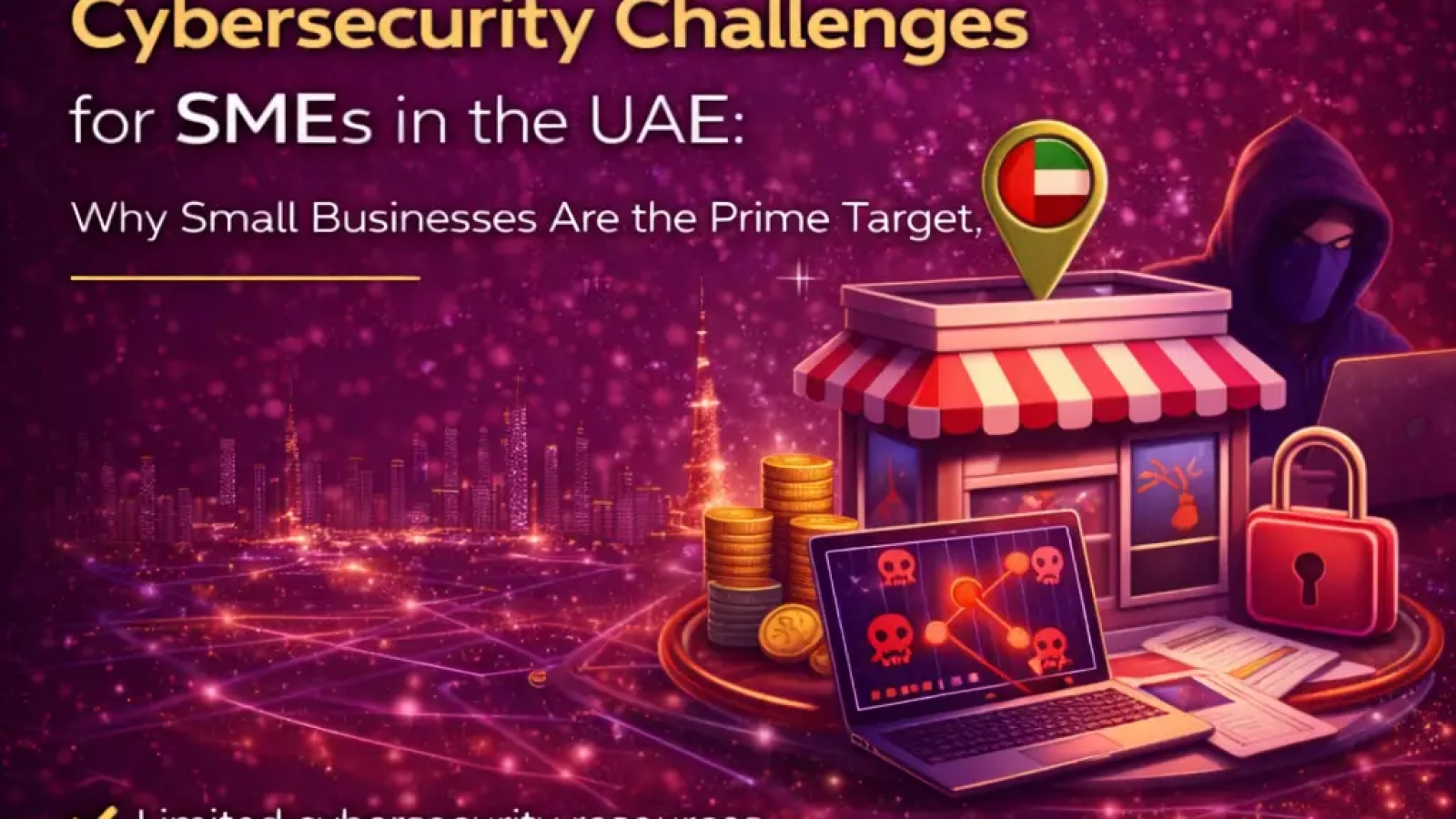
Cybersecurity Challenges for SMEs in the UAE: Why Small Businesses Are the Prime Target
Cybersecurity is often perceived as a concern only for large enterprises, banks, or government entities. In reality, small and medium-sized enterprises (SMEs) in the UAE are now the primary targets of cyberattacks. Attackers increasingly view SMEs as easier, faster, and more profitable entry points.
Many UAE SMEs believe they are “too small to be targeted.” This assumption is not only incorrect—it is one of the main reasons cybercriminals succeed.
This article explains why SMEs are prime targets, the most common cybersecurity challenges they face, and what practical steps can reduce risk.
Why Cybercriminals Prefer Targeting SMEs
Cyberattacks today are largely automated and opportunistic. Attackers are not always looking for high-profile victims; they are looking for weak defenses.
SMEs typically have:
- Limited IT budgets
- Minimal cybersecurity oversight
- Overworked staff handling IT informally
- No dedicated security policies or incident plans
From an attacker’s perspective, SMEs offer high success rates with low effort.
The UAE Context: Digital Growth Without Security Maturity
The UAE has aggressively promoted digital transformation, cloud adoption, remote work, and e-commerce. While this has accelerated business growth, security practices have not always kept pace—especially among SMEs.
Cybersecurity oversight and national awareness initiatives are supported by entities such as the UAE Cybersecurity Council and the Telecommunications and Digital Government Regulatory Authority (TDRA). However, implementation at the SME level remains inconsistent.
The Most Common Cybersecurity Challenges Faced by SMEs
1. Weak or Reused Passwords
Despite awareness campaigns, password hygiene remains one of the biggest vulnerabilities.
Common issues include:
- Reused passwords across systems
- Shared logins between employees
- No multi-factor authentication (MFA)
- Credentials stored insecurely
Once one account is compromised, attackers often gain access to multiple systems.
2. Phishing and Social Engineering Attacks
Phishing remains the most effective attack method against SMEs.
Attackers exploit:
- Fake invoices and payment requests
- Email impersonation of suppliers or management
- WhatsApp and SMS-based scams
- Urgent requests that bypass verification
Because SMEs often lack formal verification procedures, employees act quickly—and attackers succeed.
3. Lack of Endpoint Protection
Many SMEs rely solely on basic antivirus software—or none at all.
This exposes them to:
- Ransomware
- Spyware and keyloggers
- Remote access trojans
- Silent data exfiltration
Endpoints such as laptops and desktops are often the weakest link, especially with remote or hybrid work models.
4. Cloud Misconfigurations
SMEs increasingly use cloud platforms for email, accounting, storage, and CRM. However, cloud security is often misunderstood.
Common mistakes include:
- Assuming cloud providers handle all security
- Overly broad access permissions
- No monitoring of login activity
- No backup or recovery planning
Cloud services are secure—but only when configured correctly.
5. No Backup or Incident Recovery Plan
One of the most damaging gaps is the absence of proper backups and recovery procedures.
When incidents occur:
- Businesses do not know what data is affected
- There is no clean restore point
- Operations are halted for days or weeks
Ransomware attacks are especially devastating for SMEs without isolated backups.
6. Unpatched Systems and Software
Outdated systems remain a major entry point for attackers.
SMEs often delay updates because:
- Systems are “working fine”
- Updates may disrupt operations
- No one is assigned patch responsibility
Attackers actively scan for known vulnerabilities and exploit them at scale.
The Real Impact of a Cyber Incident on SMEs
Unlike large organizations, SMEs rarely have the resilience to absorb cyber losses.
Consequences often include:
- Business downtime and lost revenue
- Loss of customer trust
- Legal and regulatory exposure
- Permanent data loss
- Reputational damage
In many cases, SMEs never fully recover from a major cyber incident.
Compliance Is Becoming a Business Requirement
Cybersecurity is no longer just an IT issue—it is a governance and compliance issue.
SMEs increasingly face:
- Client cybersecurity questionnaires
- Contractual security requirements
- Data protection obligations
- Audit and assurance expectations
Failing to meet basic security standards can result in lost business opportunities, even without an actual attack.
Why SMEs Delay Cybersecurity Investments
Common reasons include:
- Viewing cybersecurity as a cost, not protection
- Overconfidence in “common sense” controls
- Assuming insurance will cover losses
- Belief that attacks only affect large firms
Unfortunately, attackers rely on these exact assumptions.
Practical Steps SMEs Can Take to Reduce Risk
Cybersecurity does not require enterprise-level budgets to be effective.
SMEs should focus on:
- Enforcing strong passwords and MFA
- Training staff to recognize phishing attempts
- Deploying basic endpoint security and monitoring
- Implementing proper cloud backups
- Restricting system access based on roles
- Creating a simple incident response plan
Consistency matters more than complexity.
Final Thoughts
SMEs are not targeted despite being small—they are targeted because they are small. Cybercriminals know that smaller businesses often lack the controls, awareness, and recovery capability of larger organizations.
In the UAE’s increasingly digital economy, cybersecurity is no longer optional for SMEs. It is a fundamental requirement for business continuity, compliance, and long-term survival.
Investing in basic cybersecurity controls today is far less costly than responding to a serious incident tomorrow.
Add a Comment
You must be logged in to post a comment