
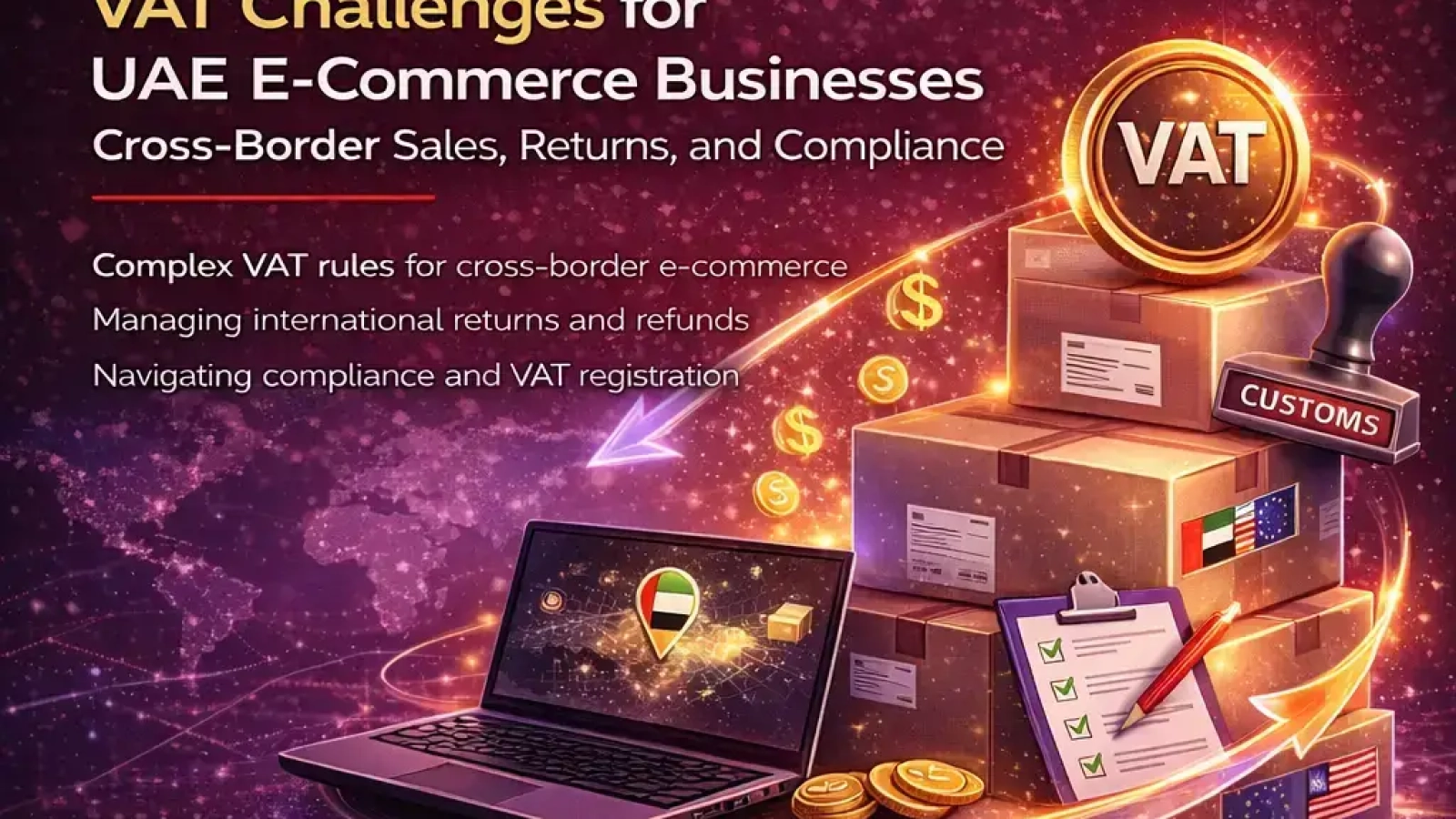
VAT Challenges for UAE E-Commerce Businesses: Cross-Border Sales, Returns, and Compliance
The UAE e-commerce sector has grown rapidly over the last few years, driven by digital adoption, logistics innovation, and changing consumer behavior. While this growth presents enormous commercial opportunities, it also exposes businesses to increasingly complex VAT challenges. Many e-commerce operators underestimate VAT risks—particularly in cross-border sales, product returns, and ongoing compliance—until issues arise during audits or assessments by the tax authorities.
This article explains the most common VAT challenges faced by UAE e-commerce businesses and provides practical insights on how to manage them effectively.
Understanding VAT in the UAE E-Commerce Context
VAT in the UAE is governed by Federal Decree-Law No. 8 of 2017 and is administered by the Federal Tax Authority (FTA). While the standard VAT rate of 5% appears straightforward, its application in e-commerce transactions can be significantly more complex than in traditional brick-and-mortar retail.
E-commerce businesses often deal with:
- Multiple jurisdictions
- Digital platforms and marketplaces
- Third-party logistics providers
- Cross-border suppliers and customers
Each of these factors affects VAT treatment.
Cross-Border Sales: One of the Biggest VAT Risk Areas
1. Selling Goods Outside the UAE
When a UAE e-commerce business exports goods to customers outside the UAE, these sales may qualify for zero-rated VAT, provided strict documentary evidence is maintained. This includes:
- Customs export declarations
- Shipping and airway bills
- Proof of delivery outside the UAE
A common mistake is assuming that all international shipments are automatically zero-rated. In reality, insufficient documentation can result in the FTA reclassifying the sale as standard-rated, leading to VAT liabilities, penalties, and interest.
2. Importing Goods for Online Sales
Many e-commerce companies import inventory into the UAE before selling it locally or regionally. VAT is generally payable at customs at the time of import.
Challenges arise when:
- Import VAT is paid but not properly reconciled with VAT returns
- Import documentation does not match accounting records
- Goods are imported under incorrect HS codes
These discrepancies often trigger VAT audits.
3. Digital Services and Overseas Platforms
If a UAE e-commerce business sells digital services (such as subscriptions, downloads, or software access) to customers outside the UAE, VAT treatment depends on the customer’s location and status. Similarly, using foreign platforms or advertising services can trigger reverse charge VAT obligations, which many businesses fail to recognize or report correctly.
VAT on Returns, Refunds, and Cancellations
Product returns are a normal part of e-commerce, but VAT handling on returns is one of the most misunderstood areas.
1. Issuing Credit Notes Correctly
When customers return goods and receive a refund, VAT previously charged must be adjusted through a valid tax credit note. Common errors include:
- Refunds processed without issuing VAT credit notes
- Credit notes issued without referencing the original tax invoice
- Incorrect VAT adjustments in the VAT return
These mistakes can result in VAT being overstated or understated.
2. Partial Returns and Exchange Scenarios
In cases where:
- Only part of an order is returned
- Goods are exchanged instead of refunded
VAT treatment becomes more complex. Businesses must ensure that VAT is adjusted only on the returned portion and that exchange transactions are properly invoiced.
Marketplace and Platform-Based Sales
Many UAE e-commerce sellers operate through marketplaces rather than selling directly via their own websites.
Key VAT challenges include:
- Determining who is responsible for charging VAT (seller vs platform)
- Commission and service fee VAT treatment
- VAT on logistics, fulfillment, and warehousing services
In some cases, the platform may charge VAT on commissions, while the seller remains responsible for VAT on the underlying sale. Misunderstanding this split is a frequent cause of non-compliance.
VAT Registration Thresholds and Timing
E-commerce businesses often scale quickly. A common compliance failure is late VAT registration.
- Mandatory registration threshold: AED 375,000 taxable supplies
- Voluntary registration threshold: AED 187,500
Many startups track revenue informally and miss the exact point at which registration becomes mandatory. Late registration can lead to:
- Backdated VAT liabilities
- Administrative penalties
- Disallowed input VAT claims
Record-Keeping and Documentation Challenges
The FTA places strong emphasis on proper record-keeping. E-commerce businesses must retain:
- Tax invoices and credit notes
- Customs documentation
- Payment gateway reports
- Platform sales summaries
- Inventory and return logs
Disorganized or incomplete records often lead to unfavorable audit outcomes, even when VAT has been paid correctly.
Technology and System Limitations
Another major issue is reliance on systems that are not VAT-configured for the UAE.
Common problems include:
- Incorrect VAT calculation on checkout
- VAT applied to zero-rated exports
- Manual adjustments outside the accounting system
- Lack of integration between e-commerce platforms and accounting software
VAT compliance should be system-driven, not spreadsheet-driven.
How UAE E-Commerce Businesses Can Reduce VAT Risk
To manage VAT effectively, e-commerce businesses should:
- Conduct regular VAT health checks
- Clearly map VAT treatment for all transaction types
- Automate VAT calculations and reporting
- Reconcile VAT returns with customs and platform data
- Seek professional advice before expanding cross-border operations
Proactive compliance is far more cost-effective than dealing with penalties after an audit.
Final Thoughts
VAT compliance in UAE e-commerce is no longer a simple box-ticking exercise. Cross-border sales, frequent returns, digital platforms, and rapid scaling have made VAT a strategic business risk. Businesses that treat VAT as an afterthought often face assessments, penalties, and operational disruption.
A structured VAT framework—supported by proper systems, documentation, and expert guidance—is essential for sustainable growth in the UAE e-commerce market.
Add a Comment
You must be logged in to post a comment